
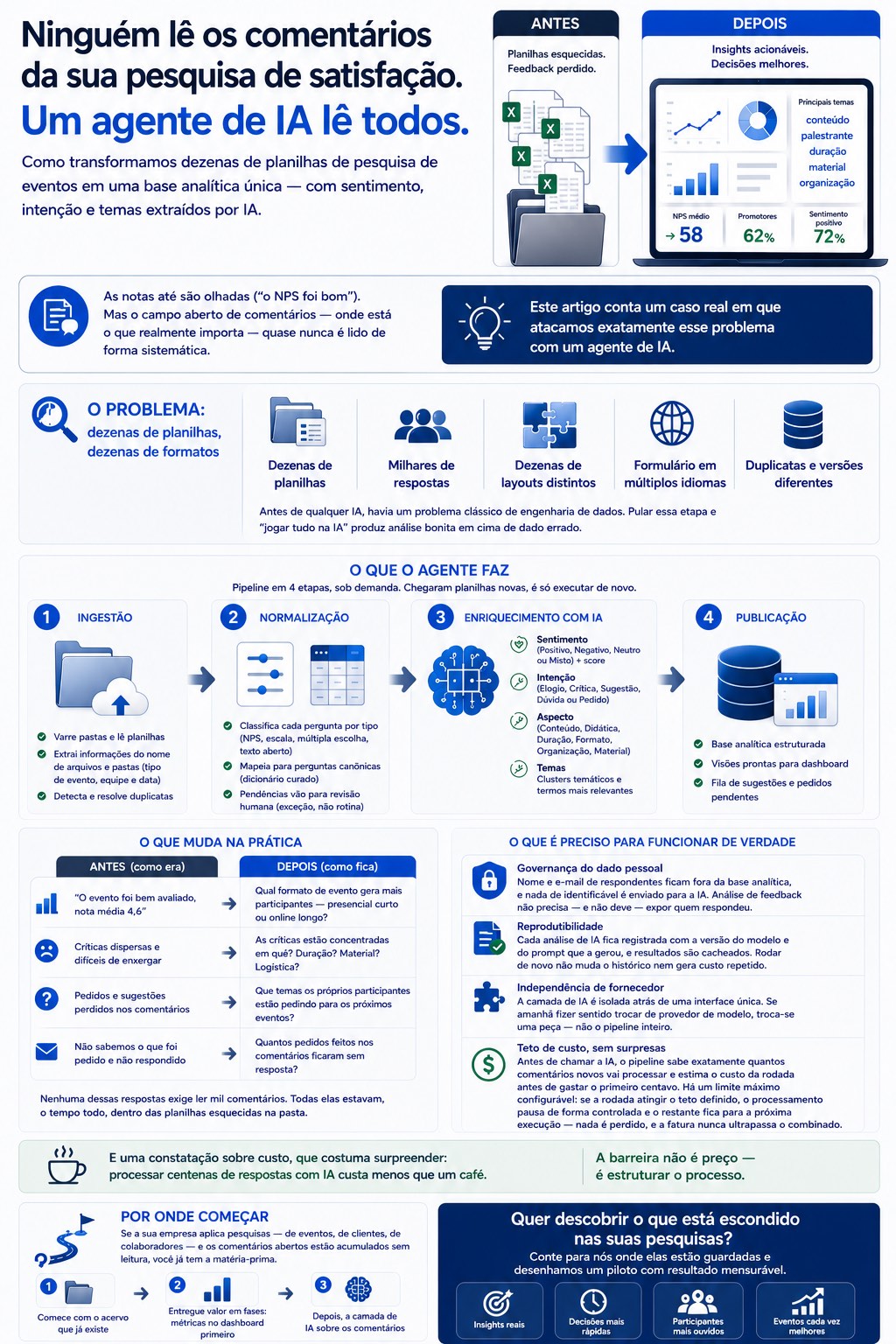
Every company that runs events — training sessions, conferences, client meetups, roadshows — repeats the same ritual: at the end, it sends out a satisfaction survey. And then what always happens, happens. The responses become a spreadsheet, the spreadsheet goes into a folder, and the folder becomes a graveyard of feedback.
The scores do get looked at ("the NPS was good"). But the open comment field — exactly where the participant writes what they really think — is almost never read systematically. Not out of neglect: reading, interpreting, and tabulating hundreds of comments by hand simply doesn't fit into anyone's routine.
This article tells a real case where we tackled exactly that problem with an AI agent.
The problem: dozens of spreadsheets, dozens of formats
The scenario we found is probably similar to yours. A client that runs dozens of events per year, each with its own satisfaction survey done through an online form. The total: dozens of spreadsheets and thousands of responses.
The detail that kills any manual analysis: every form was slightly different from the next. During the survey, we found dozens of distinct layouts across the files. The same question appeared worded differently ("recommend this event", "recommend this session"), identical scales with different labels, forms in multiple languages, columns with speaker names embedded in the question title, duplicate files with different versions.
In other words: before any artificial intelligence, there was a classic data engineering problem. And that's the first lesson from the project — skipping that step and "throwing everything at AI" produces pretty analysis on top of wrong data.
What the agent does
We designed a four-stage pipeline that runs on demand: new spreadsheets arrive, you just run it again — it only processes what it hasn't seen yet.
1. Ingestion. The agent scans the folders, reads each spreadsheet, and also extracts what's outside it: event type, responsible team, and date, which were encoded in the file and folder names. Duplicates are detected and resolved automatically.
2. Normalization. This is where the invisible work that makes everything work happens. Each question is classified by type (NPS, satisfaction scale, multiple choice, open text) and mapped to a canonical question — a curated dictionary that understands that "recommend this event" and "recommend this session" are the same metric. What the dictionary doesn't recognize goes into a pending-review report for human review: curation still exists, but becomes the exception, not the routine.
3. AI enrichment. This is where open comments stop being dead text. For each comment, the agent extracts:
- Sentiment — positive, negative, neutral, or mixed (because real people praise and criticize in the same sentence), with a score that allows tracking evolution over time;
- Intent — praise, criticism, suggestion, question, or request. A comment like "Loved the format! Could you make the material available?" is both praise and a request — and requests deserve follow-up, not just tabulation;
- Aspect — what the person is talking about: content, speaker delivery, duration, format, organization, materials. This makes it possible to answer questions like "what generates more criticism: the content or the logistics?";
- Themes — comments are automatically grouped into thematic clusters, and the most relevant terms are extracted per event and overall.
4. Publication. Everything is recorded in a structured analytical database, with ready-made views for dashboards: NPS by event, average satisfaction by criterion, sentiment over time, themes ranked by volume of criticism, and a queue of suggestions and requests pending a response.
What changes in practice
Before: "the event was rated well, average score 4.6". After, the conversation changes entirely:
- Which event format draws more participants — a short in-person event or a long online one?
- What are the criticisms concentrated on? Duration? Materials? Logistics?
- What themes are participants themselves requesting for upcoming events?
- How many requests made in the comments went unanswered?
None of these answers requires reading a thousand comments. They were all, the whole time, sitting inside spreadsheets forgotten in a folder.
What it takes to actually work
Four precautions made the difference in this project — and apply to any similar initiative:
- Personal data governance. Respondent names and emails stay out of the analytical database, and nothing identifiable is sent to the AI. Feedback analysis doesn't need to — and shouldn't — expose who responded.
- Reproducibility. Every AI analysis is logged with the model and prompt version that generated it, and results are cached. Running it again doesn't change the history or generate repeated cost.
- Vendor independence. The AI layer is isolated behind a single interface. If it makes sense to switch model providers tomorrow, you swap one piece — not the entire pipeline.
- Cost cap, no surprises. One of companies' biggest fears with AI is uncontrolled token consumption. Here it's solved by design: before calling the AI, the pipeline knows exactly how many new comments it's going to process and estimates the cost of the run before spending a single cent. And there's a configurable maximum limit: if a run hits the defined cap, processing pauses in a controlled way and the rest is left for the next run — nothing is lost, and the bill never exceeds what was agreed.
And a finding about cost that tends to surprise people: processing hundreds of responses with AI costs less than a cup of coffee. The barrier isn't price — it's structuring the process.
Where to start
If your company runs surveys — of events, clients, or employees — and the open comments are piling up unread, you already have the raw material. The approach we recommend is the same one we followed here: start small, with the archive that already exists, and deliver value in phases — first the structured metrics in a dashboard, then the AI layer on top of the comments.