
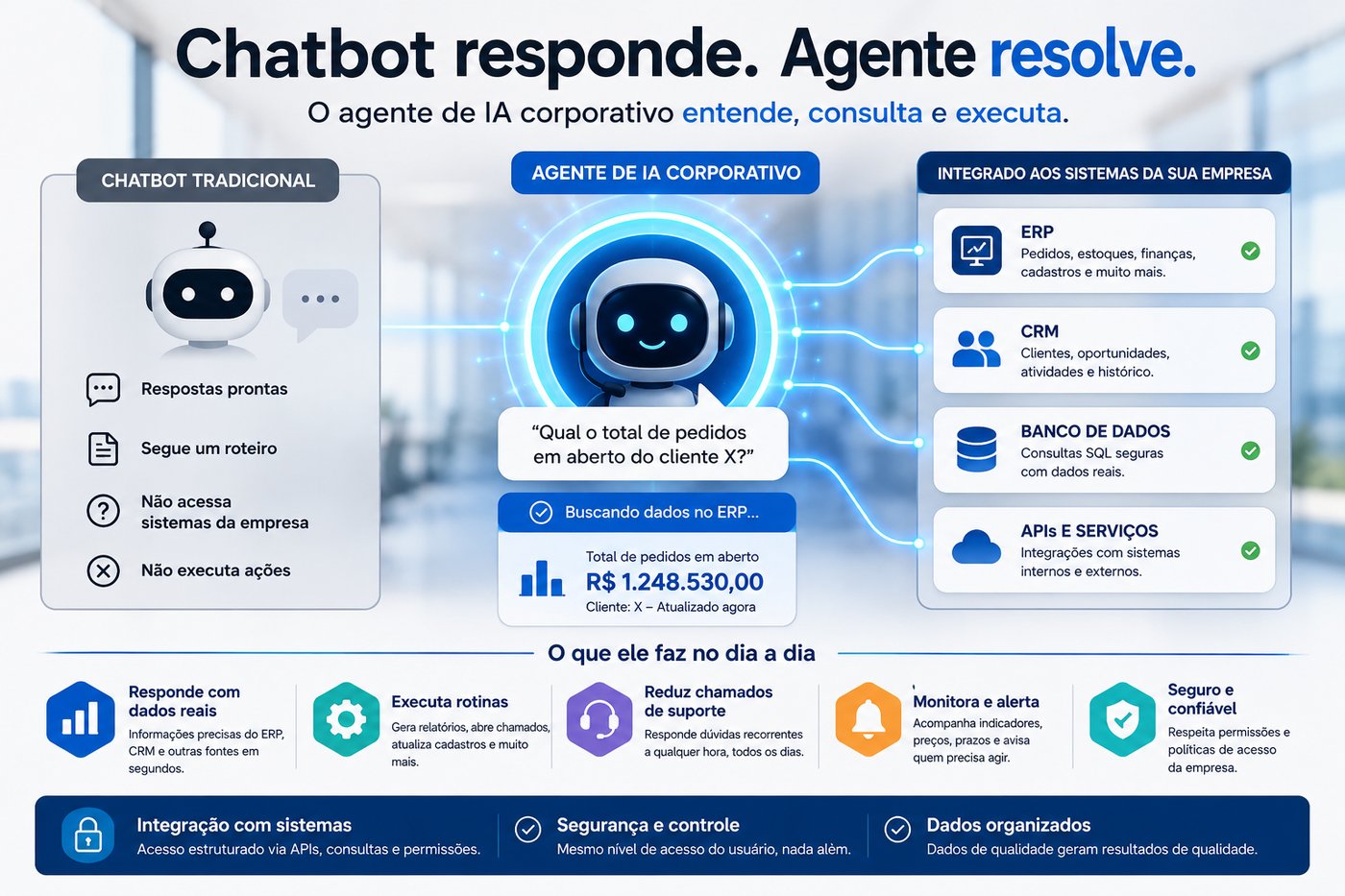
A chatbot answers. An agent solves.
A traditional chatbot follows a script: it recognizes keywords and returns canned answers. A corporate AI agent is connected to the company's systems — ERP, CRM, database — and uses language models to understand what you need, find the information where it lives, and act. It's not an FAQ page with a chat interface; it's a digital colleague with (controlled) access to the systems.
What it does day to day
- Answers with real data: "what's the total open orders for client X?" no longer requires navigating screens and filters — the answer comes back in seconds, straight from the ERP.
- Executes routines: generating a report, opening a ticket, updating a record. Tasks that follow clear rules can be delegated.
- Reduces support tickets: a good share of internal tickets are repeated questions about "how to do X" in the system. The agent answers immediately, any time.
- Monitors and alerts: agents also work without being called — watching indicators, competitor prices, or deadlines, and notifying whoever needs to act.
What it takes to actually work
The quality of a corporate agent depends on three foundations. Integration: it needs structured access to the systems — APIs, queries, permissions. This is where ERP experience makes a difference, because you need to understand the data at the source. Security: the agent must respect the same access controls as the user; whoever can't see salaries on the system screen can't see them through the chat either. Organized data: AI doesn't fix bad records — it amplifies what it finds. Companies with clean data extract value much faster.
Where to start
The most common mistake is starting too big. The approach that works is a pilot with a tight scope: one process, one group of users, one measurable result — for example, the agent answering ERP questions for the administrative team, measuring the drop in tickets. Within weeks there's concrete evidence of value, and expansion becomes a decision based on results, not a bet.
That's the logic Cyberpolos used to build its products: the ERP Assistant, which answers and runs queries in the system in natural language, and MIA, a market intelligence agent that monitors competitors and trends. Focused use cases, measurable results.