
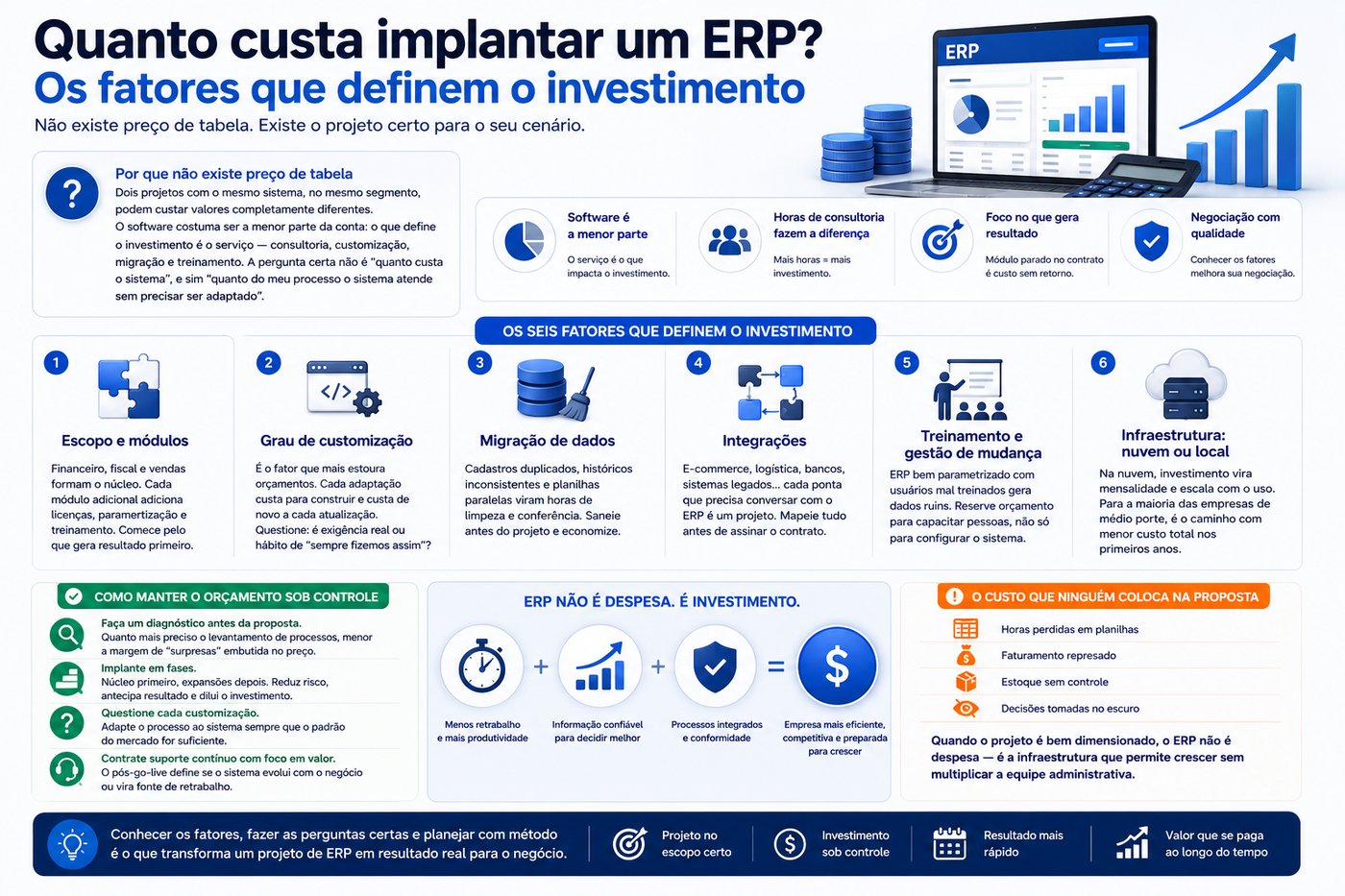
Why there's no list price
Two projects with the same system, in the same industry, can cost completely different amounts. That happens because the software is usually the smallest part of the bill: what defines the investment is the service — how many hours of consulting, customization, migration, and training your scenario requires. Over more than two decades implementing ERPs, we've seen that the right question isn't "how much does the system cost", but "how much of my process does the system handle without needing to be adapted".
The six factors that define the investment
1. Scope and modules. Finance, tax, and sales form the core of most projects. Every additional module — production, WMS, maintenance, HR — adds licenses, configuration, and training. Start with what generates results first; a module sitting unused in the contract is cost without return.
2. Degree of customization. This is the factor that blows budgets more than any other. Every custom-built screen, report, or rule costs to build and costs again with every system upgrade. The question to ask before every customization: is it a genuine business requirement, or just the habit of "that's how we've always done it"?
3. Data migration. Duplicate records, inconsistent history, and parallel spreadsheets turn into hours of cleanup and reconciliation. Companies that clean up their data before the project save a significant slice of the implementation.
4. Integrations. E-commerce, logistics, banks, legacy systems — every endpoint that needs to talk to the ERP is a small project within the project. Map all of them before signing the contract, because an integration discovered midway is a guaranteed change order.
5. Training and change management. The most underestimated part. A well-configured ERP with poorly trained users produces bad data — and bad data undermines everything that comes after, from tax compliance to BI. Set aside budget to train people, not just to configure the system.
6. Infrastructure: cloud or on-premises. The cloud turned investment into a subscription: instead of servers and perpetual licenses, a recurring cost that scales with usage. For most mid-sized companies, it's the path with the lowest total cost in the first few years — but the math should be done case by case.
How to keep the budget under control
- Run a diagnostic before the proposal. The more precise the process assessment, the smaller the margin for "surprises" baked into the price.
- Implement in phases. Core first, expansions later. Reduces risk, delivers results sooner, and spreads out the investment.
- Question every customization. Adapt the process to the system whenever the market standard is good enough.
- Contract ongoing support focused on value. The post-go-live phase determines whether the system evolves with the business or becomes a source of rework.
The cost nobody puts in the proposal
There's also the cost of not implementing: hours lost in spreadsheets, delayed billing, uncontrolled stock, decisions made in the dark. When the project is properly sized, the ERP isn't an expense — it's the infrastructure that lets you grow without multiplying your administrative headcount.